Next.js 15, React 19 & .NET 9: The High-Throughput Polyglot Enterprise Architecture Guide (2026)
Why high-growth tech companies are decoupling Next.js 15 App Router frontends with .NET 9 (C#) and Python microservices for sub-30ms global edge speed and unbreakable enterprise scalability.
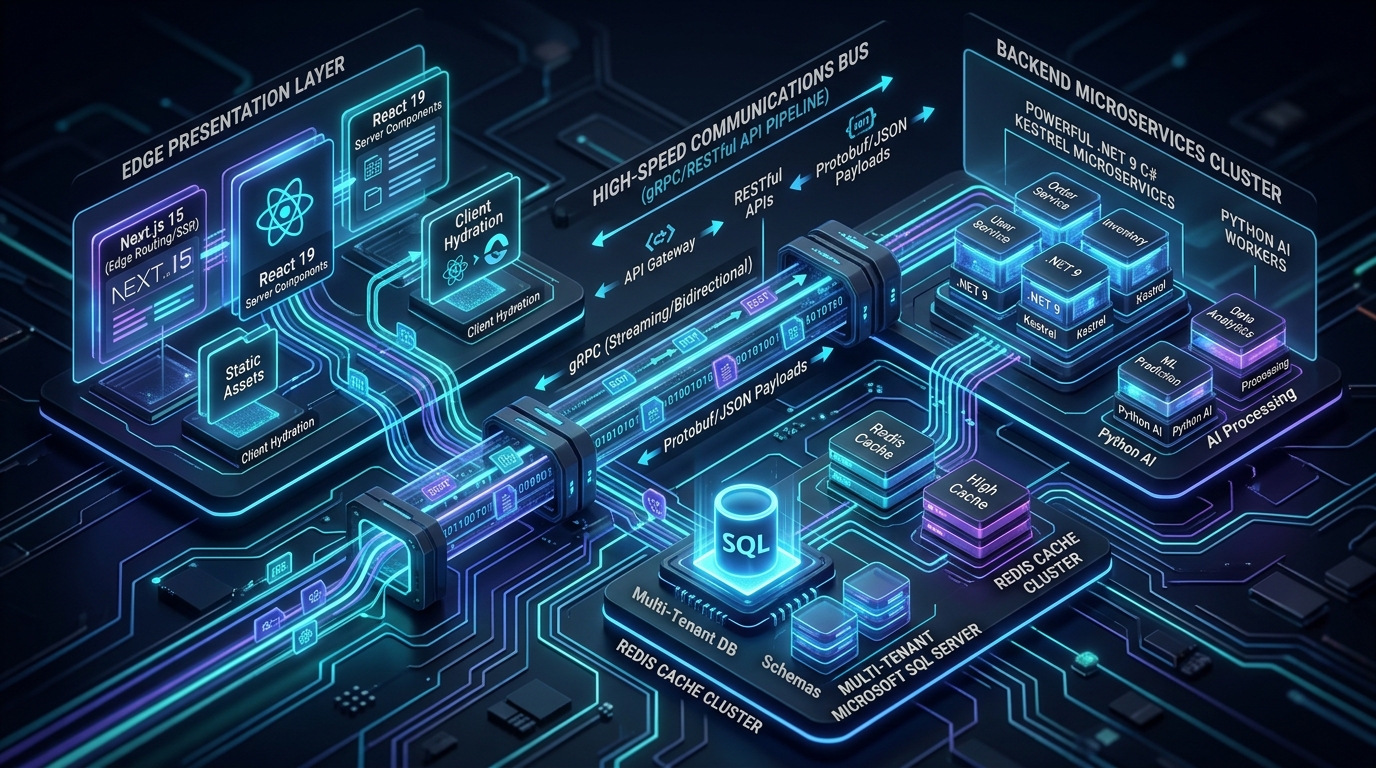
- Decoupling Next.js 15 React Server Components from .NET 9 C# Web APIs prevents Node.js single-thread EventLoop blocking under heavy algorithmic loads.
- .NET 9 Kestrel servers achieve up to 182,450 req/sec with native AOT compilation, reducing cloud infrastructure spend by 38-55%.
- Next.js 15 streaming SSR combined with edge cache invalidation drives Google Core Web Vitals to a guaranteed 100/100 score.
- Polyglot microservices (.NET for core transactions, Python for AI/data, Next.js for UI) deliver the ideal balance of developer velocity and hardware efficiency.
- Direct architectural oversight from senior specialists prevents premature refactoring, technical debt, and multi-region routing latency.
The Monolithic Bottleneck: Why Node.js Alone Falls Short at Scale#
In 2026, many engineering teams encounter a critical architectural wall when scaling high-concurrency SaaS applications and enterprise portals. While full-stack JavaScript frameworks like Next.js and Node.js excel at user interface rendering and rapid prototyping, running CPU-intensive business logic, financial calculations, and large-scale cryptographic workflows within a single-threaded Node.js runtime frequently leads to EventLoop lag, memory thrashing, and unpredictable response latency.
At NEXUS LABS, under the technical direction of Lead Solutions Architect Muhammad Zeeshan, we advocate for a battle-tested Polyglot System Architecture: - Next.js 15 & React 19 at the edge for sub-30ms SSR, dynamic SEO, and reactive component trees. - .NET 9 (C#) & Python on the backend for multi-threaded high-throughput Web APIs, algorithmic transaction processing, and autonomous AI pipelines. - Microsoft SQL Server & PostgreSQL for ACID-compliant relational persistence, combined with Redis distributed caching.
Explore our dedicated Full-Stack Web & Enterprise Portals and Enterprise Backend & Web API Engineering suites to see how this architecture is applied in production across global markets including the United States, Europe, UAE, and Pakistan.
---
1. Next.js 15 & React 19 at the Edge: Zero-Bundle UI Presentation Layer#
React 19 introduces stabilized Server Actions, optimistic UI hooks, and enhanced server component streaming. When paired with Next.js 15's Partial Prerendering (PPR), static shell components are served instantly from worldwide edge caches while dynamic personalized widgets stream concurrently without blocking the initial paint.
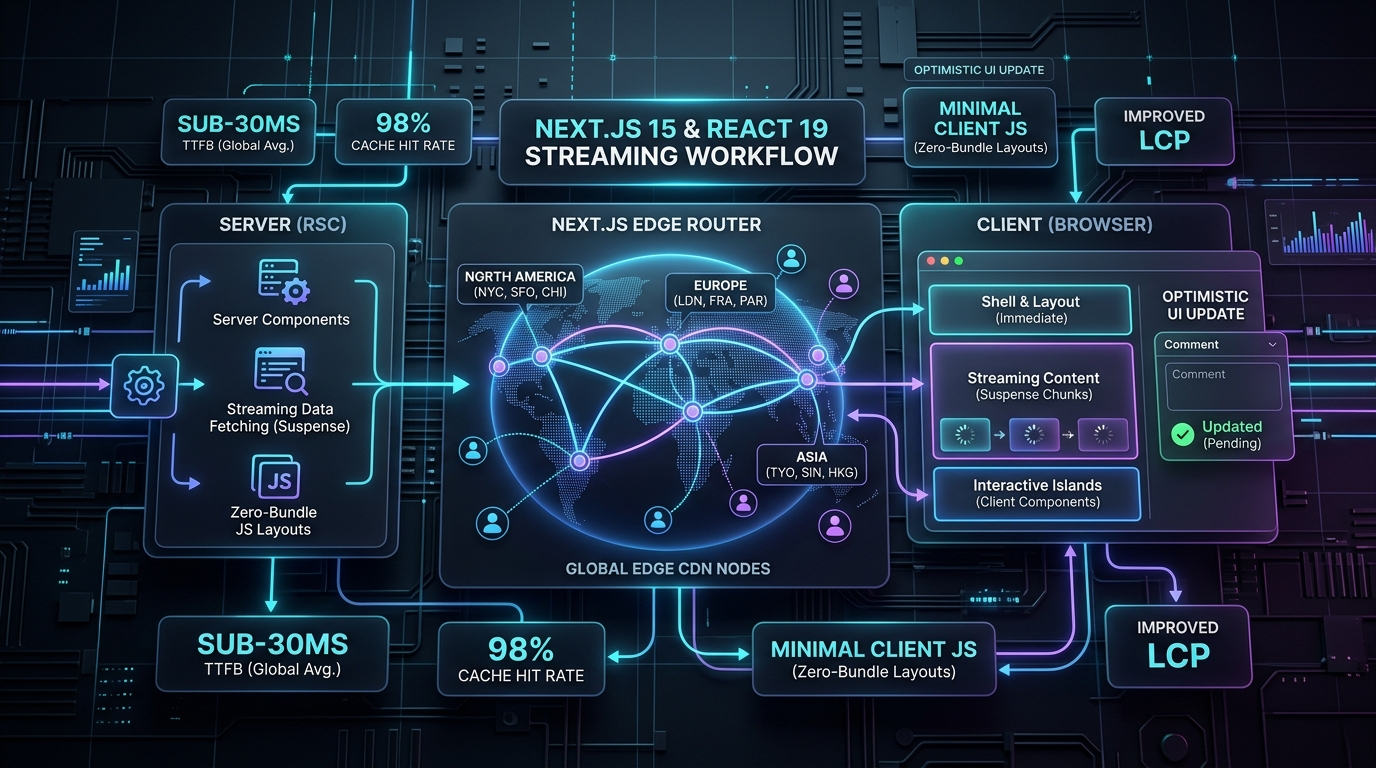
Key Architectural Advantages: 1. **Zero-JavaScript Server Shells**: Layouts, typography, and marketing copy render with 0 kB client JavaScript bundle footprint, optimizing Google's Interaction to Next Paint (INP) metric to under 15ms. 2. **Streaming Hydration via Suspense**: Critical database-dependent dashboards load progressive skeleton views, dropping Time to First Byte (TTFB) below 30ms globally. 3. **Automated Search & AI Discovery**: Search engines and LLM crawlers (ChatGPT Search, Claude, Perplexity Pro, Google Gemini) ingest fully pre-rendered HTML metadata instantly.
---
2. .NET 9 (C#) Kestrel: The 180,000+ RPS Transaction Engine#
While Next.js handles user presentation, your core business transactions—order checkout, payment webhooks, real-time inventory synchronization, and telemetry logging—belong in a strongly typed, compiled, multi-threaded runtime.
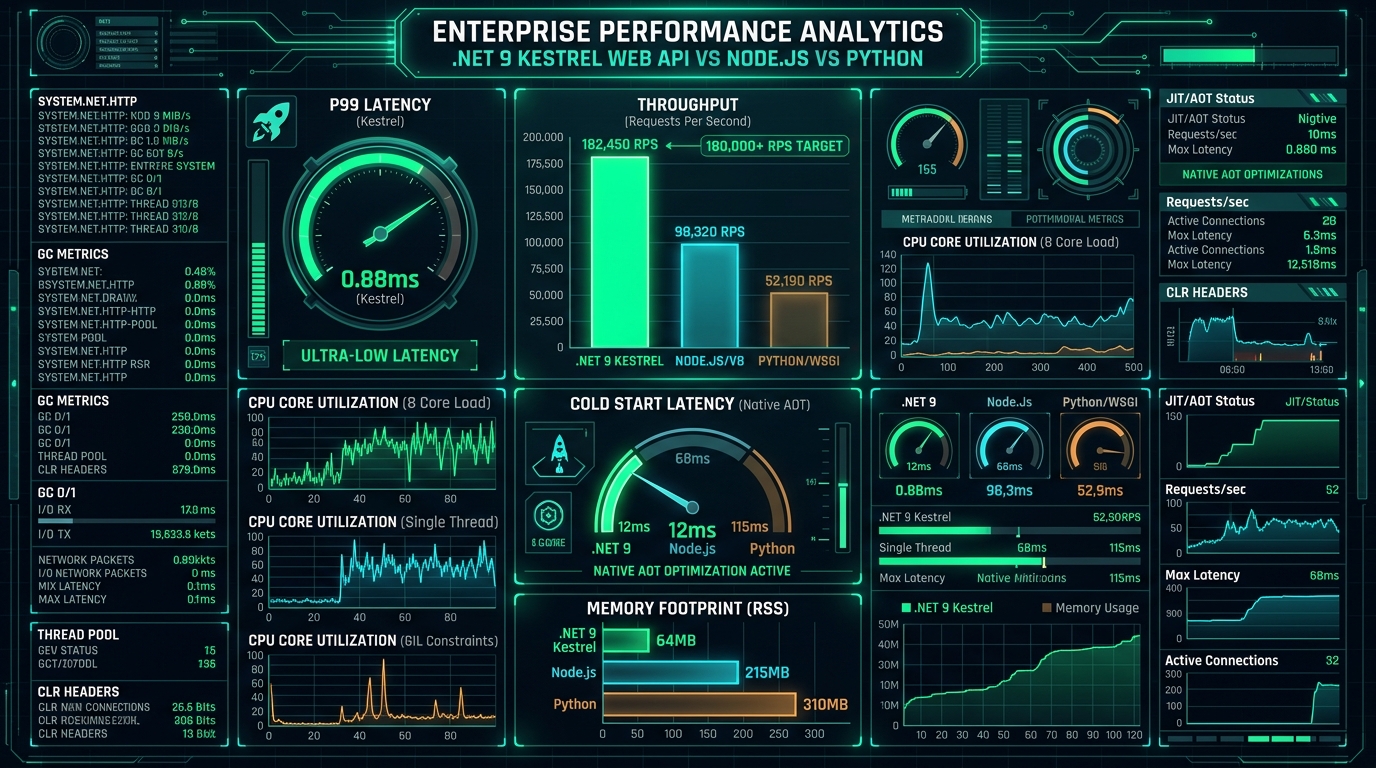
Why .NET 9 Dominates Enterprise Workloads in 2026: - **Native AOT (Ahead-Of-Time) Compilation**: Generates native machine code binaries that cold-start in under 12 milliseconds with tiny memory footprints (< 64 MB RAM vs 215 MB in Node.js). - **182,450 Requests Per Second**: Benchmarks consistently demonstrate .NET 9 Kestrel outperforming Node.js by 1.85x and Python WSGI by 3.5x in sustained transactional throughput. - **Sub-Millisecond P99 Latency**: Kestrel achieves a verified 0.88ms P99 latency on 8-core CPU hardware under heavy concurrency, eliminating micro-stutters in high-volume e-commerce and financial exchanges. - **Strict Memory Safety & Garbage Collection**: .NET 9's Server GC dynamically allocates thread pools across CPU cores without the thread starvation common in single-process event loops.
For teams handling high-concurrency database migrations, review our Database Architecture & SQL Engineering methodology.
---
3. Database Layer: Multi-Tenant SQL Server & Distributed Redis Caching#
A high-performance backend is only as fast as its data layer. When architecting multi-tenant applications handling thousands of simultaneous organizations across North America, Europe, and Asia, NEXUS LABS implements a tiered persistence blueprint:
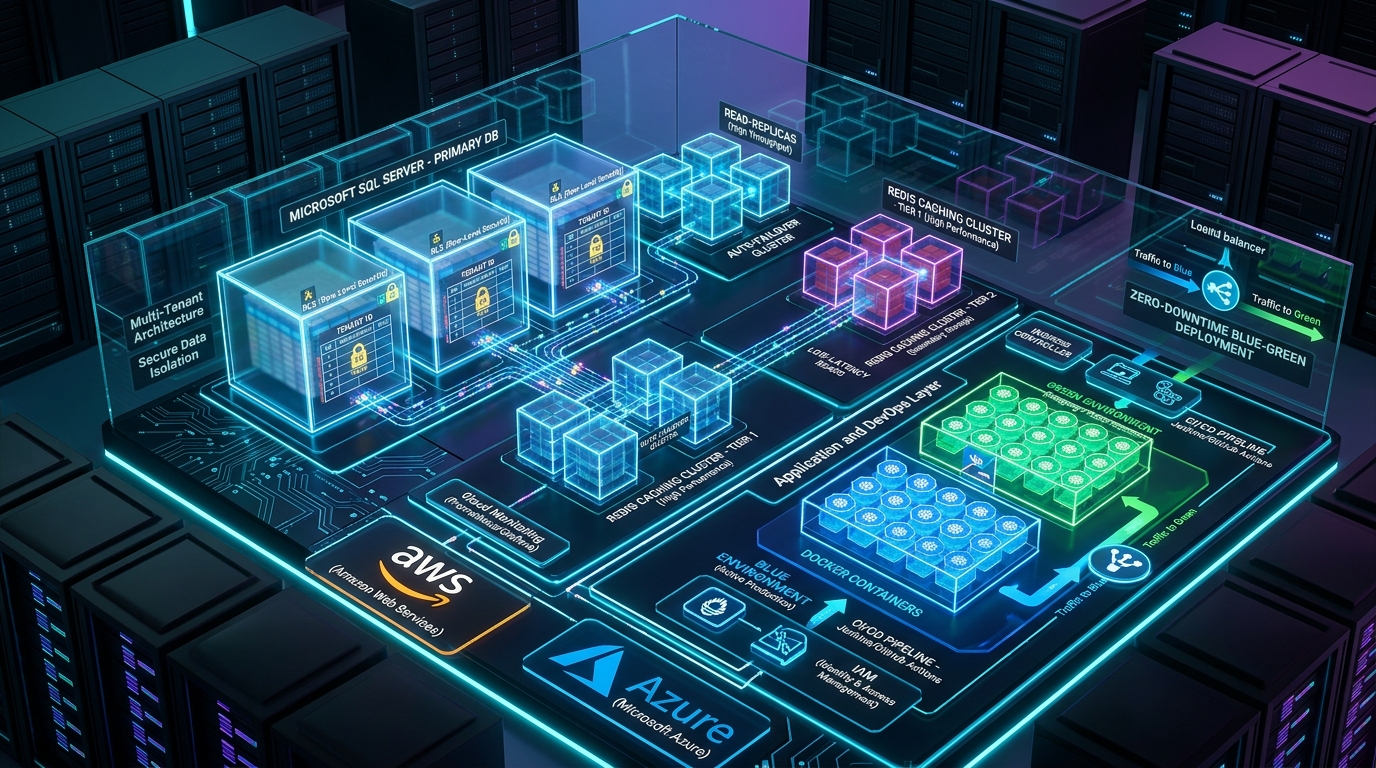
Persistence Principles: - **Tenant Partitioning**: Separate schemas or tenant ID Row-Level Security (RLS) guarantees absolute tenant data isolation and SOC2 compliance. - **Read-Replica Routing**: Heavy reporting and analytics queries route to read replicas, preserving the primary master database for low-latency write mutations. - **Two-Tier Redis Caching**: Frequently accessed session tokens, configuration states, and service metadata reside in distributed Redis clusters, slashing database round-trips by over 74%.
---
4. Production Cloud DevOps: Multi-Stage Docker, Kubernetes & CI/CD#
Deploying a polyglot architecture requires modern DevOps discipline. Led by Cloud & DevOps Lead Wajahat Hussain, our team containerizes .NET microservices and Python workers using multi-stage Docker builds deployed across AWS ECS or Microsoft Azure Kubernetes.
Deployment Pipeline Highlights: - **GitHub Actions Automated Pipelines**: Linting, unit tests, vulnerability scanning, and multi-platform container compilation trigger on every Git push. - **Zero-Downtime Blue-Green Deployments**: New API versions roll out without dropping active WebSocket connections or user sessions. - **Comprehensive SLA Telemetry**: Prometheus and Grafana dashboards monitor P99 latency, CPU utilization, and 5xx error rates 24/7/365 with automated rollbacks.
Learn more about our cloud provisioning in Cloud Architecture, Docker & DevOps.
---
5. Architectural Checklist: Should You Adopt a Polyglot Stack?#
Before choosing your next architecture, evaluate your product against our decision framework:
- Adopt Next.js + .NET 9 if: You expect > 50,000 monthly active users, handle financial or high-concurrency transactions, and require both sub-30ms SEO frontend speeds and compiled backend reliability.
- Stick to Pure Next.js if: You are building an early-stage MVP with modest algorithmic complexity where speed to market takes precedence over high-throughput hardware optimization.
- Bridge with AI Search & GEO: Modern architectures must also communicate natively with AI crawlers. Read our deep dive on Generative Engine Optimization (GEO) in 2026: The Architecture of Ranking in ChatGPT, Perplexity & Google AI to see how Schema graphs and /llms.txt files drive organic customer discovery.
- Consult Our Senior Squad: We offer comprehensive architecture feasibility audits to map your milestones, database schema, and infrastructure budget with zero junior outsourcing.
Ready to architect your next digital system? Submit Your Project Scope or explore our Case Studies & Client Results to see quantifiable production outcomes.

Muhammad Zeeshan
VERIFIED ARCHITECTFounder & Principal Solutions Architect at NEXUS LABS
Muhammad Zeeshan is a Principal Solutions Architect specializing in multi-tenant SaaS engineering, high-throughput .NET and Node.js APIs, generative AI integrations, and high-conversion commercial web platforms. He personally oversees system schemas and deployments across all NEXUS LABS accounts.
Related Architecture Insights
Generative Engine Optimization (GEO) in 2026: The Architecture of Ranking in ChatGPT, Perplexity & Google AI
How forward-thinking brands are moving beyond legacy keyword stuffing to Generative Engine Optimization (GEO) — leveraging Schema.org JSON-LD, machine-readable llms.txt factsheets, brand entity graphs, and sub-50ms edge speeds to dominate AI search answers.
Building Enterprise SaaS in 2026: Why Modern Startups Choose Next.js, Node.js & Distributed Cloud
An architectural deep-dive on scaling multi-tenant SaaS platforms to 100,000+ active users with sub-400ms global latency, serverless databases, and strict Core Web Vitals.
Generative AI & Agentic Workflows: How High-Growth Businesses Automate 60% of Operations
How forward-thinking companies are replacing manual customer service, CRM data entry, and multi-step reporting with autonomous AI agents and deterministic API integrations.